
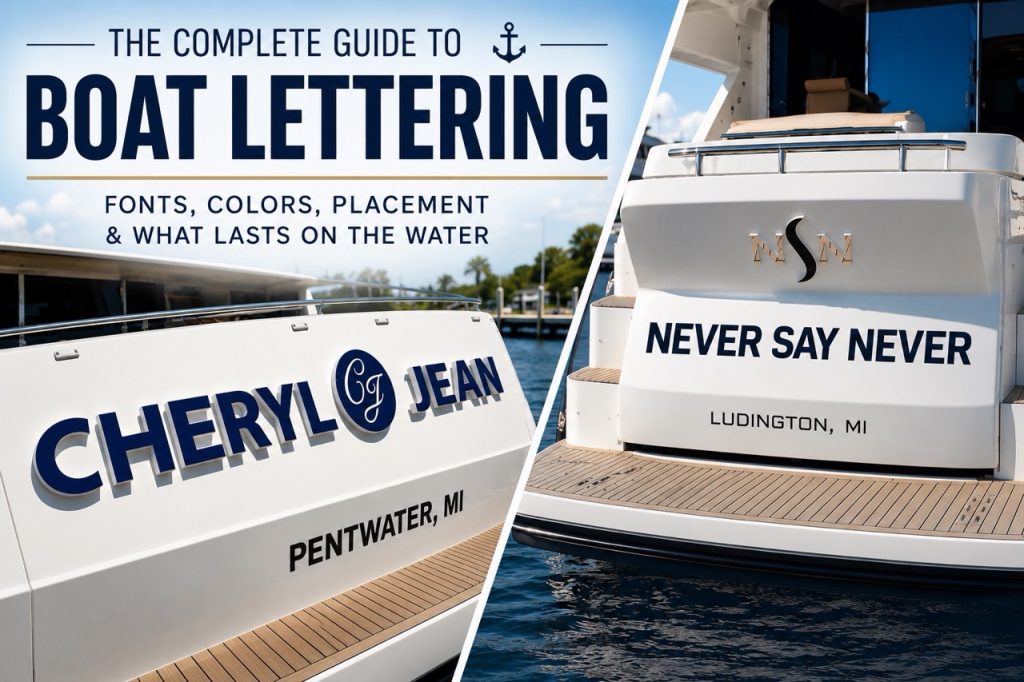
Whether you just picked up a new vessel or you’re finally giving your old girl the name she deserves, boat lettering is one of the most important decisions you’ll make as a boat owner. It’s the first thing people see when you pull into the marina. It’s what shows up in photos. And done right, it tells the world exactly what kind of captain you are.
This guide covers everything: fonts, colors, placement rules, materials, and how long you can expect your lettering to last. By the end, you’ll know exactly what to ask for and what to avoid.
Why Boat Lettering Matters More Than You Think
Most boat owners treat lettering as a finishing touch. It’s actually much more than that.
Good boat lettering does three things at once: it identifies your vessel legally, expresses your personality, and protects your investment. A well-lettered boat holds its value better, photographs better, and makes a statement that plain hulls simply can’t.
There’s also a practical side. In most U.S. states, your boat name must appear on the stern in letters no smaller than 4 inches tall. If you’re documented with the Coast Guard, the name must appear on both sides of the bow as well. Getting this right from the start means you’re never scrambling at the dock or during a registration inspection.
Choosing the Right Font for Boat Lettering
Font choice is the single biggest design decision you’ll make. It sets the entire tone of your boat’s identity.
Serif Fonts (Classic and Traditional) Think elegant letterforms with small finishing strokes on each character. Serif fonts read as timeless and established. They work beautifully on larger yachts and sailing vessels where a formal, distinguished look fits the vessel’s character. Names like Serenity or Endeavour pair naturally with a clean serif.
Bold Block and Sans-Serif Fonts (Modern and High-Contrast) Clean, no-frills letterforms that read clearly from a distance, even in low light or across choppy water. These are a strong choice for sportfishing boats, center consoles, and powerboats where readability matters as much as style. They also hold up well in smaller sizes, which matters when you’re working with a limited transom space.
Script and Brush Fonts (Personality-Forward) Script lettering has a hand-crafted, personal feel. It works well for playful names and smaller recreational boats. The trade-off is readability at a distance, script can be harder to read quickly, especially at size. If you go this route, pair it with a contrasting shadow or outline to improve legibility.
One rule applies to every font: avoid anything too thin or too ornate. Fine lines look great on paper and terrible on a fiberglass hull from 50 feet away.
Not sure which font fits your boat and name? Try our Boat Lettering Design Tool and preview your exact name in dozens of fonts and sizes before you order.
Best Colors for Boat Lettering
Color is where most people either get it exactly right or completely overthink it. The guiding principle is simple: contrast is everything.
Your lettering needs to stand out clearly against your hull color, not blend into it. Here are the combinations that work most reliably:
White hulls: Navy, black, dark red, or deep forest green all read sharply. Gold or chrome adds a luxury feel.
Dark blue or navy hulls: White and gold are the classic pairing. Light silver also works well.
Black hulls: White, chrome, or bright accent colors like red or electric blue create strong contrast.
Two-tone or striped hulls: Match one color from the hull design and use it as a shadow or outline color. This ties the lettering into the overall look rather than fighting it.
Chrome, gold, and brushed silver finishes are popular on higher-end vessels and lighted signs. They pick up dock lighting and sunlight beautifully, adding dimension that flat colors simply can’t match. If you’re considering a lighted yacht sign, metallic finishes combined with LED backlighting create a dramatic nighttime effect that turns heads in any marina.
One more thing worth knowing: UV fading is real. Cheaper vinyl colors, especially reds and yellows, can shift noticeably after a season or two in direct sun and saltwater exposure. Always ask specifically for marine-grade vinyl with UV protection. Our vinyl boat lettering is rated for 7 or more years of outdoor marine exposure without significant fading.
Where to Place Your Boat Lettering
Placement isn’t just an aesthetic decision. There are legal requirements depending on how your vessel is registered.
Stern (Transom) Lettering This is the most common placement and the most visible from the dock. The boat name goes on the transom, typically centered or slightly above center. For documented vessels, the hailing port (usually the city and state) appears directly below the name in smaller letters.
Bow Lettering USCG-documented vessels must display the vessel name on both sides of the bow. This is typically positioned on the upper portion of the hull, angled slightly to follow the bow’s natural lines. State-registered boats are not required to have bow lettering, but many owners add it for a finished, professional look.
Size Requirements Your boat name must be a minimum of 4 inches tall for federally documented vessels. The hailing port has no minimum size specified, but convention puts it at roughly half the height of the name lettering. Registration numbers must be at least 3 inches tall, displayed on both sides of the bow in a color contrasting the hull.
Leave enough clearance from the waterline to account for wake spray. Lettering placed too low gets submerged regularly, which shortens its lifespan significantly even with marine-grade materials.
Not sure what size and placement is right for your specific vessel? Browse our Boat Lettering Gallery to see real examples on different hull types and sizes.
Vinyl Boat Lettering vs. LED Illuminated Lettering
Both options have a place depending on your boat, your budget, and how you use your vessel.
Vinyl Boat Lettering Vinyl is the most popular and accessible option. It’s cost-effective, highly customizable, and when you’re using quality marine-grade film, extremely durable. Our vinyl boat lettering is cut precisely from marine-grade vinyl with a UV-resistant topcoat and built to take years of salt, sun, and wake exposure.
Best for day boats, recreational powerboats, sailboats, pontoons, or any vessel where the primary goal is a clean, professional name on the transom.
LED Illuminated Lighted Signs Illuminated signs are in a different category entirely. LED lettering lights up from within, making your vessel’s name visible from a significant distance at night. It’s a dramatic look that’s become increasingly popular on larger yachts, charter vessels, and boats used for evening entertaining at the dock.
Best for yachts 40 feet and up, charter boats, vessels that frequent marinas at night, or any owner who wants a premium presence on the water.
See our full range of LED Yacht Signs here including lighted transom signs, illuminated name plates, and custom LED lettering built to marine specs.
How Long Does Boat Lettering Last?
This depends almost entirely on the quality of the vinyl and the installation.
Quality marine-grade vinyl from reputable suppliers like 3M or Avery, applied with a UV laminate, will typically last 5 to 10 years with proper care. Budget vinyl, the kind often used by low-cost online print services, tends to fade, peel at the edges, or crack within 1 to 3 years. The savings up front usually cost more in replacements over time.
A few things that shorten the life of any lettering: placing it too close to the waterline where it goes through constant submersion cycles, power washing directly across the letter edges, extended exposure to direct sun without a cover, and applying over rough, oxidized, or freshly waxed gel coat.
To get the most out of your lettering, rinse with fresh water after saltwater use, hand wash with mild soap rather than pressure washing, and apply a UV-protectant spray to the vinyl once or twice a season.
Ready to Design Your Boat Lettering?
Now that you know what makes great boat lettering. The next step is seeing it come to life on your actual boat name.
Our Boat Lettering Design Tool lets you type in your boat’s name, choose your font and color, and preview exactly how it will look before you place your order. No commitment, no guessing, no back-and-forth.
If you’re ready to take it further with a fully illuminated sign, explore our LED Yacht Sign options or visit our Yacht Sign Gallery for inspiration from real builds.
Have questions about sizing, placement, or what’s right for your specific boat? Contact us directly, we’ve been building custom marine signs for over 35 years and are happy to help you get it right.
Yacht Brite Signs specializes in custom boat lettering, lighted yacht signs, and marine branding. Based in Michigan and Florida, we ship throughout the United States.